Florida Crane and Rigging Umbrella and Excess Liability
Insurance
or Call Us: (813) 442-4179
If your crane tips over a Brickell sidewalk during a tandem pick, your $1M General Liability policy won't come close to covering the damage. A single dropped load can injure workers, crush vehicles, and shut down a city block for days. The resulting claims routinely climb past primary limits within weeks.
That's why umbrella and excess liability for Florida crane and rigging companies has moved from optional to mandatory on most serious bids. In 2026, general contractors, hospital systems, and public agencies are writing $5M to $10M limits directly into subcontracts. If your insurance doesn't match, you don't get the job.
The details matter as much as the limit. Underlying policy requirements, exclusions buried in the umbrella form, and mismatched renewal dates can leave you exposed even when your certificate shows the right number. A carrier can deny a claim long after the job is finished, and the contractor holding your certificate won't care why.
This guide walks you through what contracts actually require, how carriers structure high-limit towers, where the gaps hide, and what drives your premium. The goal is simple: you should understand your coverage well enough to spot problems before a claim does it for you.
The High Stakes of Florida Crane and Rigging Operations
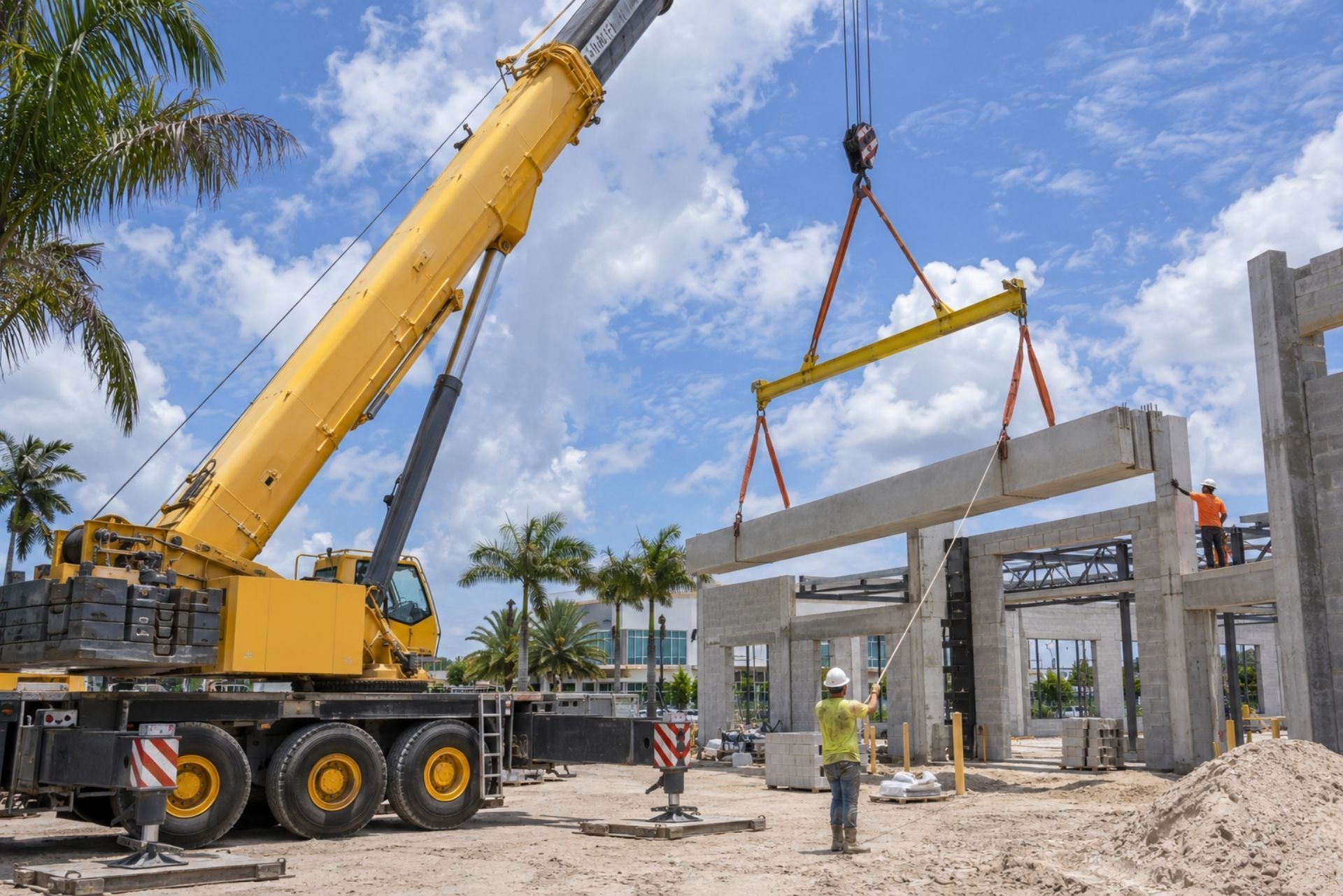
Crane work concentrates enormous risk into a few seconds of activity. A 200-ton crawler lifting HVAC units onto a Tampa medical office building carries exposure that a framing crew or a landscaping company never faces. When something goes wrong, the losses stack quickly: third-party bodily injury, property damage, business interruption claims from neighboring tenants, and the cost of the load itself.
Florida adds its own pressures. Afternoon thunderstorms produce sudden wind gusts that exceed manufacturer limits mid-pick. Sandy and fill soils near the coast can shift under outrigger pads. High-rise construction in Miami-Dade and Fort Lauderdale puts lifts directly over occupied streets, transit lines, and adjacent buildings.
The legal climate shapes your exposure too. Florida uses a modified comparative fault system that bars recovery for claimants found more than 50% at fault. That sounds favorable to defendants, but it changes how litigation plays out. Since the 2023 reforms, insurers have adopted more aggressive fault allocation strategies, which means every party on a job site works hard to push blame onto someone else.
Here's what that means for you. As the crane operator, you're often the most visible target. Plaintiffs, the general contractor's carrier, and other subcontractors all have reasons to argue the rigging failed rather than the steel connection or the site plan.
Consider a realistic claim mix from a single dropped load in downtown Orlando:
- Injured ironworker suit: $2.5M
- Damaged parked vehicles and storefront: $400,000
- Adjacent tenant business interruption: $600,000
- Defense costs over three years: $350,000
That's $3.85M before anyone argues about punitive damages. A $1M primary policy is gone in the first month.
Meeting the $5M to $10M Contractual Requirements
Subcontract insurance exhibits have grown longer and more specific. Five years ago, a $2M umbrella satisfied most commercial builders. Today, government and institutional projects in Florida, including hospitals and public infrastructure, now standardly mandate $5M to $10M in total liability coverage.
Event work follows a similar pattern. Large-scale Florida venues and festivals frequently require a $2M General Liability base plus a $5M Umbrella to account for crowd density and equipment failure. If you set staging, lighting trusses, or LED walls for events in Miami or Jacksonville, expect that structure.
Why General Contractors Demand Higher Limits
General contractors aren't asking for $10M out of habit. Their own carriers and project owners require it, and the requirement flows downhill. A GC building a hospital tower in Sarasota answers to a health system with a risk management department, a lender, and often a bonding company.
Your limits also protect the GC's own policy. When your coverage responds first as primary and noncontributory, the GC's loss history stays clean. Many GCs now run subcontractor prequalification software that automatically flags certificates below threshold, so a $3M umbrella gets rejected before a human ever reads your bid.
The Difference Between Umbrella and Excess Liability
These terms get used interchangeably, but they aren't the same product.
An umbrella policy sits above your underlying policies and can broaden coverage. Some umbrella forms "drop down" to cover claims your primary policy excludes, subject to a self-insured retention. A true excess policy is usually "follow form," meaning it only covers what the underlying policy covers, with no broader terms.
For crane operators, the distinction matters. A follow-form excess layer inherits every exclusion in your GL. If your primary policy excludes a certain type of lift work, your $9M of excess excludes it too. Most $10M towers combine a lead umbrella of $5M with a $5M excess layer from a second carrier.
An umbrella doesn't attach to nothing. Carriers require specific minimum limits on your primary policies, and if those limits fall short, you'll pay the difference out of pocket.
Standard underlying requirements for Florida contractors typically include General Liability of $1M Per Occurrence and $2M Aggregate. Commercial auto is where many riggers get surprised. Umbrella carriers in Florida are mandating underlying commercial auto limits of $500,000 to $1,000,000 before an excess policy will attach. If you run boom trucks, carry-deck cranes, or tractor-trailers hauling counterweights, expect the high end.
Employer's Liability, the Part Two section of your workers' compensation policy, also counts as underlying coverage. Most umbrella carriers want $1M/$1M/$1M on that section. Florida's statutory workers' comp requirement doesn't set those EL limits for you, so check your policy rather than assuming.
| Underlying Policy | Typical Minimum Required | Common Mistake |
|---|---|---|
| General Liability | $1M occurrence / $2M aggregate | Aggregate not per-project |
| Commercial Auto | $500K to $1M combined single limit | Mobile cranes listed on wrong policy |
| Employer's Liability | $1M / $1M / $1M | Left at $100K / $500K / $100K defaults |
| Riggers Liability | Not an umbrella underlying policy | Assuming umbrella covers the load |
The catch is the "maintenance of underlying insurance" condition. If your auto limit is $500,000 but the umbrella schedule requires $1M, and a crash produces an $1.8M judgment, the umbrella treats it as though you carried $1M. You pay the $500,000 gap yourself.
Comparing Coverage: Standard vs. High-Limit Policies
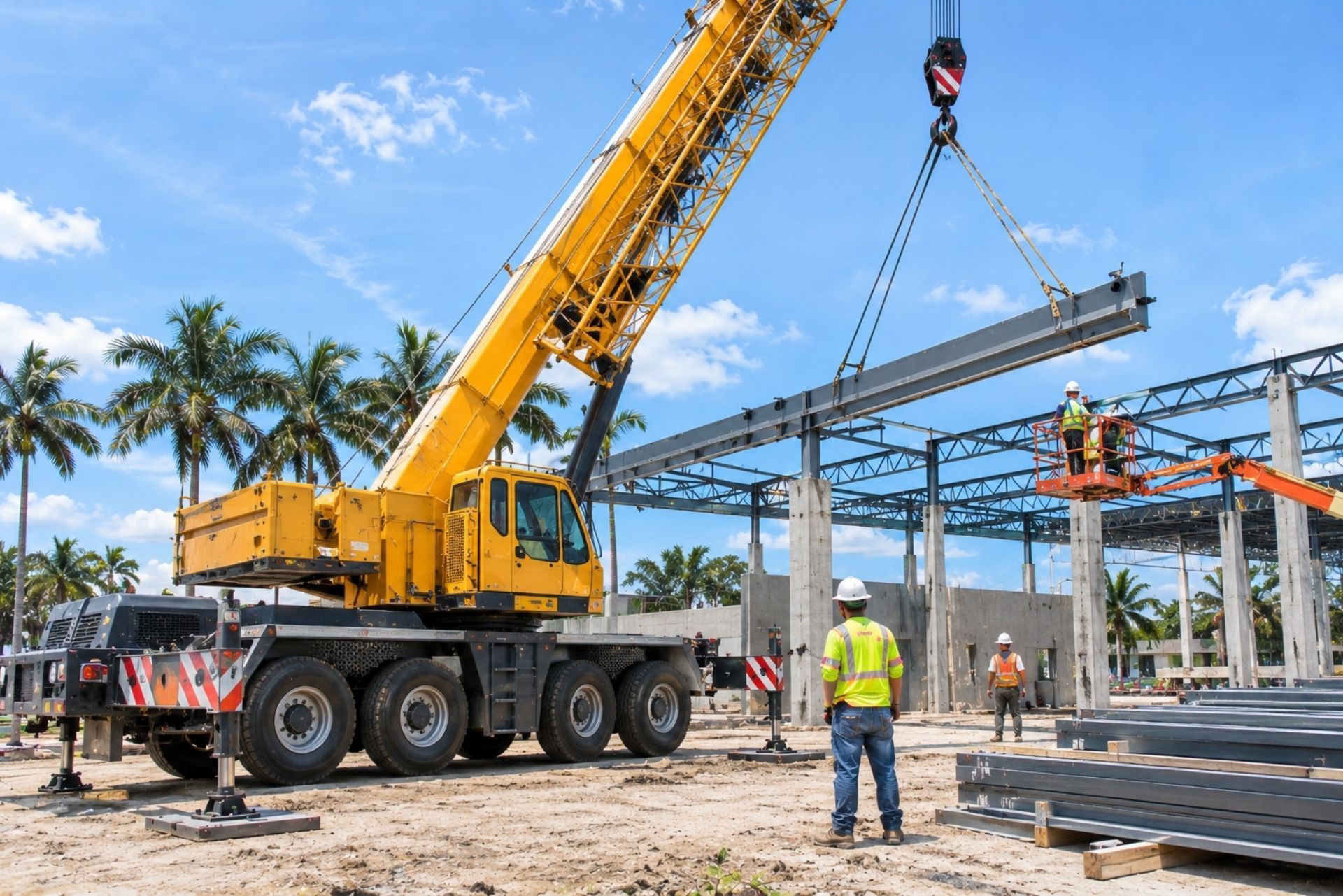
A basic contractor's insurance program and a high-limit crane tower look similar on a certificate. The differences show up in the policy language, the carriers involved, and how claims get handled.
| Feature | Standard Program ($1M to $2M Umbrella) | High-Limit Tower ($5M to $10M) |
|---|---|---|
| Typical carriers | Single admitted carrier | Multiple carriers, often surplus lines |
| Structure | One umbrella policy | Lead umbrella plus excess layers |
| Crane exposures | Often limited by tonnage or boom length | Underwritten specifically for lifting |
| Defense costs | May erode limits | Often outside limits on lead layer |
| Qualifying jobs | Small commercial, residential | Hospitals, public works, high-rise |
| Underwriting scrutiny | Basic application | Lift plans, safety program, operator certs |
The biggest practical difference is who writes the policy. Many standard-market carriers cap crane exposure or exclude units above a certain capacity. High-limit towers usually involve specialty markets that understand crane risk and price it accordingly.
One thing to keep in mind: more carriers means more coordination. Each excess carrier has its own form, and they don't always follow the lead policy perfectly. An experienced broker reads every layer, not just the lead.
There's also a difference in claim behavior. With a $10M tower, excess carriers get involved early on serious claims, sometimes appointing their own monitoring counsel. That's protective for you, but it means your claims reporting has to be prompt and thorough. Late notice to an excess carrier is one of the most common reasons coverage disputes start.
A $10M certificate can hide a policy that pays nothing on the claims most likely to hit a rigging company. These three gaps cause the most damage in Florida.
Action Over Claims and Florida Labor Laws
An action over claim happens when an injured worker, usually employed by another subcontractor, sues you directly. The worker collects workers' comp from their employer, then files a third-party suit against the crane company. Your GL defends you, and the plaintiff's employer's carrier may also pursue subrogation.
Some umbrella and GL forms written for contractors include exclusions or sublimits on injury to employees of any contractor or subcontractor on the project. On a crane job, that's most of the people standing near your load. If your policy excludes "injury to employees of contractors," you may have almost no coverage for the most common serious claim you'll face. Ask your broker directly whether such an exclusion appears anywhere in your tower.
Riggers Liability and Care, Custody, or Control
Your GL and umbrella exclude damage to property in your care, custody, or control. When you lift a $1.2M chiller onto a roof in Boca Raton and drop it, the chiller itself isn't covered by your liability tower. That's what Riggers Liability covers.
This is a maintenance versus insured loss distinction worth understanding. Riggers coverage won't pay for a worn sling you should have retired. It pays for sudden accidental damage to the customer's property during the lift. Set your riggers limit at the value of the most expensive single item you'll handle, not your average lift.
The Danger of Non-Concurrent Effective Dates
When your GL renews in March, your auto in June, and your umbrella in October, you create windows where the underlying schedule doesn't match reality. If your auto carrier non-renews and the replacement carries a lower limit, your umbrella may still list the old carrier and limit.
Align all policies to a single renewal date. It costs some short-rate adjustment once, but it ends the mismatches that produce denied claims.
Premiums for high-limit crane coverage vary widely, and no honest broker can quote a number without seeing your operation. The factors below drive where you land.
The broader market helps a little. As of early 2026, Florida's HB 837 reforms have prevented property and casualty premiums from rising an additional 14.5%. That hasn't made coverage cheap, but it has slowed increases for contractors with clean records.
Underwriters focus on these points:
- Fleet size and capacity: A shop running 20-ton carry-decks prices differently than one running 300-ton all-terrains.
- Type of work: Tower crane erection, steel erection, and critical lifts near occupied structures carry the highest rates.
- Loss history: Five years of loss runs are standard. One large bodily injury claim can affect pricing for years.
- Operator certification: NCCCO-certified operators and documented qualified riggers and signal persons matter.
- Safety documentation: Written lift plans, pre-lift meetings, and wind monitoring protocols reduce your rate.
- Bare rental vs. operated rental: Bare rentals shift risk to the renter if contracts are written correctly.
- Geography: Dense urban work in Miami-Dade usually costs more than rural infrastructure jobs.
Here's a pricing reality many owners miss. Excess layers typically cost less per million than the lead umbrella, because they sit further from the first dollar of loss. Going from $5M to $10M rarely doubles your total umbrella spend.
This matters because it changes the bidding math. If a $10M requirement opens hospital and public work in your region, the added excess layer may pay for itself on a single contract. Price the layer before you walk away from a bid.
Common Questions About Crane Insurance
Do I need umbrella insurance if my GL is already $2M? Probably, if you bid commercial or public work. Most Florida institutional projects now expect total liability of $5M to $10M, and a $2M GL alone won't meet that.
Can I buy a policy just for one big job? Some markets offer project-specific excess, but it's often costly and slow to place. An annual tower is usually more efficient if you regularly pursue large projects.
Does my umbrella cover the equipment I'm lifting? No. Damage to a customer's property during a lift falls under Riggers Liability, not your umbrella or GL.
What happens if my auto limit is lower than the umbrella requires? You become responsible for the gap. The umbrella responds as if the required underlying limit were in place.
Is umbrella the same as excess liability? Not quite. An umbrella can broaden coverage, while a follow-form excess policy only covers what the underlying policy covers.
Will a crane rental company's insurance protect me?
Rarely in a way you can count on. Rental agreements often push liability to the renter, so read the contract and confirm your own coverage applies.
Securing Your Assets for the Long Term
A high-limit tower only works when every layer fits. The certificate gets you onto the job. The policy language decides whether you survive a bad lift.
Florida's 2026 environment rewards preparation. Contracts keep asking for higher limits, insurers keep sharpening fault allocation, and specialty carriers keep scrutinizing crane operations. Owners who treat insurance as a yearly paperwork exercise tend to discover their gaps during a lawsuit.
Your next steps:
- Request your full policy forms, not just declarations pages, for every layer of your tower.
- Match underlying limits to the umbrella schedule, especially commercial auto and Employer's Liability.
- Search for contractor employee exclusions and action over limitations before your next renewal.
- Set Riggers Liability limits at your highest single-lift value.
- Align all renewal dates to eliminate schedule mismatches.
- Price a $10M tower before declining any bid that requires it.
The right coverage structure lets you bid the hospital tower, the bridge job, and the stadium event with confidence. Review your program with a broker who knows crane risk, and do it before the next big contract lands on your desk.
ABOUT THE AUTHOR: PAUL RAMENTOL
I am the Owner and President of Mesa Insurance Agency. I help individuals and business owners across Florida secure personal and business insurance coverage that supports their needs. My focus is on clear guidance, direct communication, and long-term support without call-center delays or confusion.
Contact Us

Personal Coverage Options
Insurance Built for Everyday Protection
Mesa Insurance Agency provides personal insurance coverage designed to support daily life. Our team reviews risks and coverage needs to help clients secure dependable protection at fair rates.
Dental & Vision Insurance
Coverage that helps manage routine dental and vision care costs.

Business Coverage Options
Insurance Built for Business Protection
Mesa Insurance Agency provides business insurance coverage that helps protect operations, employees, and property. We work with multiple carriers to offer coverage options that support daily business activities and long-term stability.
Commercial Auto Insurance
Coverage for business-owned vehicles, drivers, and accident-related liability exposure.
General Liability Insurance
Protection against third-party injury, property damage, and common business liability risks.
Professional Liability Insurance
Coverage for claims related to professional services, advice, or service errors.
Workers’ Compensation Insurance
Coverage that helps support employees with work-related injuries and medical costs.
Commercial Property Insurance
Protection for buildings, equipment, inventory, and physical business assets.
Errors & Omissions Insurance
Coverage for financial losses caused by mistakes, omissions, or service-related claims.
Industries We Serve
Serving Businesses Across Multiple Sectors
Mesa Insurance Agency works with business owners across Florida to provide insurance coverage that supports daily operations. We understand common risks faced by different industries and help clients secure reliable protection.

Construction and Trades Insurance
Coverage for job sites, vehicles, tools, and workplace risks.
Hospitality Businesses Insurance
Insurance for restaurants, bars, and service-based operations.

Retail and
Commercial Properties
Protection for storefronts, inventory, and customer-related liability.
Our Approach
Insurance Made Easy to Understand
Mesa Insurance Agency provides business insurance coverage that helps protect operations, employees, and property. We work with multiple carriers to offer coverage options that support daily business activities and long-term stability.
Insurance FAQs
Helpful Answers for Florida Clients
Support you can rely on.

What makes Mesa Insurance Agency different?
We are an independent agency with access to multiple carriers. This allows us to offer flexible coverage options.
Clients work directly with licensed agents. Service continues beyond the policy start date.
Do you offer coverage for individuals and families?
Yes. We provide personal insurance for individuals and families across Florida.
Coverage includes auto, home, health, life, and flood insurance. Our team explains each option clearly.
Do you work with small and mid-sized businesses?
Yes. We work with businesses of many sizes and industries.
Our team helps identify risks and secure appropriate coverage. Ongoing service is included.
Can I make changes to my policy later?
Yes. Policies can be updated as needs change.
We assist with coverage adjustments, additions, and removals. Clients can contact us directly for help.
Is flood insurance required in Florida?
Flood insurance is not always required, but it is strongly recommended in many areas.
Standard home insurance does not cover flood damage. Our team can review your flood risk and options.
How do I contact your office?
You can contact us by phone, email, or through our website.
Our team responds promptly during business hours. Support is always available when needed.
From the Blog
Insurance Topics That Matter
Clear answers for common questions.





Client Reviews
Trusted by Clients Across Florida
Mesa Insurance Agency is proud to serve individuals and businesses throughout Florida. Clients choose us for clear communication, responsive service, and reliable insurance support. Their feedback reflects our focus on long-term relationships and consistent service.
Contact Us