A single
hurricane season can reshape the financial future of a Florida business. Consider a
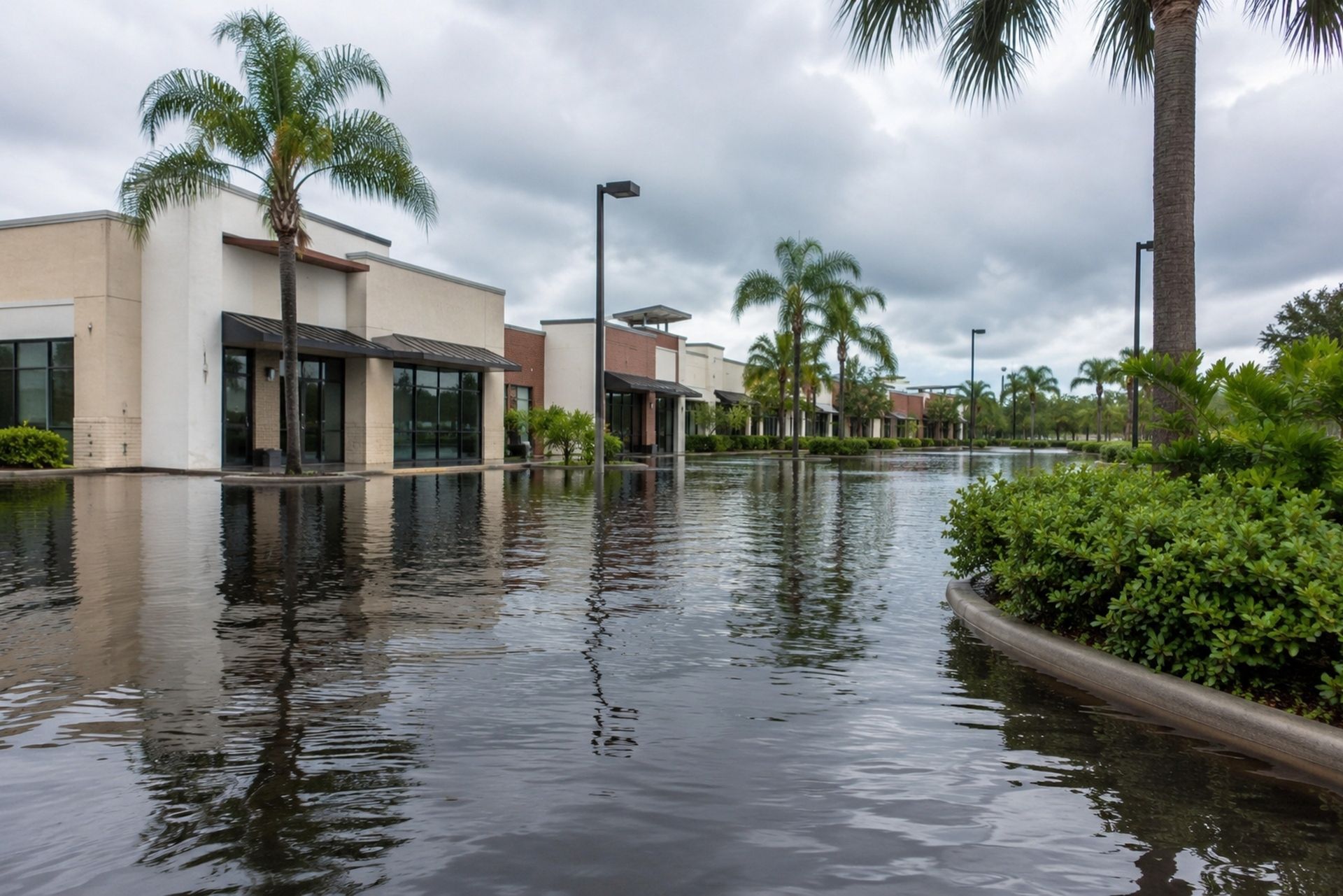
retail strip center in Fort Lauderdale that took on three feet of storm surge in 2024: the owner's
commercial property policy covered wind damage to the roof but paid nothing for the floodwater that destroyed $400,000 worth of tenant improvements and inventory on the ground floor. That gap between what
business owners assume they're covered for and what their policies actually pay is where fortunes are lost.
Florida commercial flood insurance exists to close that gap, yet a surprising number of property owners either skip it entirely or carry limits far too low to matter. With NFIP premiums mandated to rise 25% annually until they reach full actuarial rates, the cost of waiting only grows. This guide breaks down the coverage types, policy options, pricing factors, and practical steps you need to protect your commercial property from flood losses in 2026 and beyond.
Why Florida Businesses Need Dedicated Flood Coverage
Florida accounts for more NFIP flood claims than any other state, and commercial properties face unique exposure. A warehouse in Tampa sitting at eight feet of elevation and a beachfront restaurant in Destin face very different risks, but both share one reality: standard commercial property insurance excludes flood damage. That exclusion catches business owners off guard every hurricane season. The state's new flood disclosure requirements now demand that sellers and landlords inform buyers and tenants about flood history, which signals how seriously regulators treat this exposure.
The Difference Between Commercial Property and Flood Insurance
Your commercial property policy covers fire, wind, theft, and certain water damage from burst pipes. It does not cover rising water from storm surge, overflowing rivers, or heavy rainfall accumulation. Flood insurance is a separate policy entirely, whether purchased through the NFIP or a private carrier. Many business owners in Jacksonville or Orlando assume their "all-risk" commercial policy handles everything, but the flood exclusion is standard across virtually every carrier. If water enters your building from the ground up rather than the sky down, you need a dedicated flood policy.
Common Flood Risks in the Sunshine State
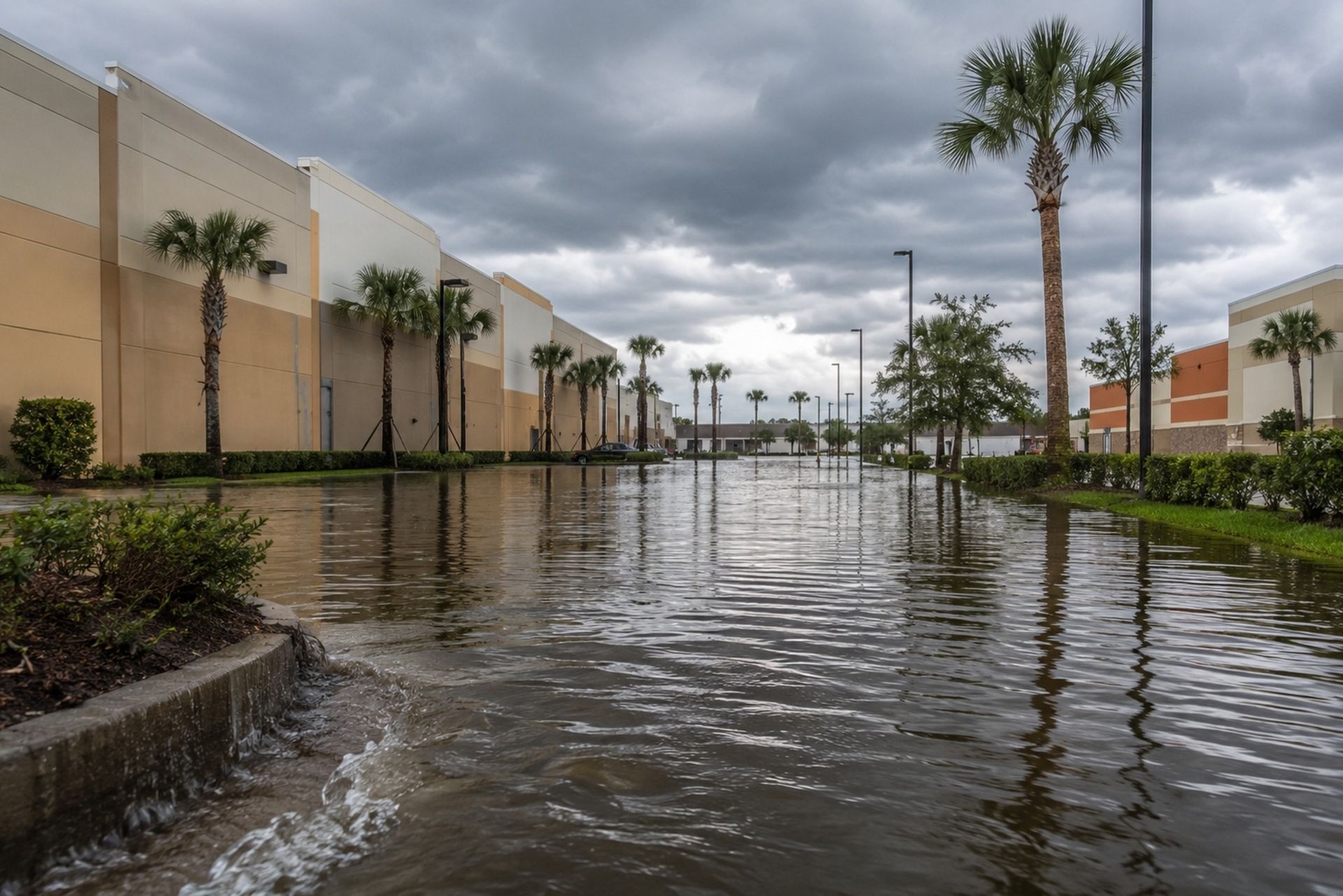
Florida's geography creates multiple flood scenarios beyond hurricanes. Coastal storm surge threatens properties from Miami-Dade to the Panhandle. Inland flooding from heavy rainfall routinely damages businesses along the St. Johns River basin and in low-lying areas of Hillsborough County. King tides now push saltwater into commercial districts in Miami Beach several times per year. Even properties outside high-risk flood zones file claims: roughly 25% of all NFIP claims come from moderate- and low-risk zones. A landscaping company's equipment yard in Sarasota or a boutique hotel in St. Augustine can flood without a named storm ever making landfall.
Commercial flood policies split coverage into two distinct categories. Understanding each one helps you avoid buying too little protection for your specific situation.
Building Property Coverage
Building coverage protects the physical structure itself: foundation, walls, electrical systems, plumbing, HVAC equipment, and permanently installed fixtures. Under the NFIP, commercial building coverage maxes out at $500,000. For a small office or retail space, that limit may suffice. For a mid-size warehouse, manufacturing facility, or multi-tenant commercial building, $500,000 often falls short of replacement cost. Private flood carriers can write limits well above that threshold, sometimes up to $10 million or more. The key is matching your coverage limit to your building's actual replacement value, not its market value or mortgage balance.
Personal Business Property (Contents) Coverage
Contents coverage pays for inventory, furniture, equipment, and other movable business property damaged by floodwater. The NFIP caps contents coverage at $500,000 for commercial policies. A catering company in Orlando with $200,000 in kitchen equipment and a $150,000 food inventory could easily approach that limit. Businesses with high-value contents, such as medical practices with imaging equipment or retailers with seasonal stock, should evaluate whether NFIP limits are sufficient or whether a private policy with higher limits makes more sense.
Comparing NFIP vs. Private Flood Insurance
The choice between a federal NFIP policy and a private flood policy is one of the most consequential decisions you'll make. Here's how they compare in 2026:
| Feature | NFIP | Private Flood |
|---|---|---|
| Max Building Coverage | $500,000 | $10M+ (varies by carrier) |
| Max Contents Coverage | $500,000 | $5M+ (varies by carrier) |
| Business Interruption | Not available | Often available as add-on |
| Waiting Period | 30 days | Varies: some as low as 10 days |
| Premium Trend | 25% annual increases under Risk Rating 2.0 | Market-driven, may be lower |
| Claims Handling | Federal process | Private adjuster, often faster |
| Availability | Any community in NFIP program | Depends on carrier appetite |
NFIP policies have long been the default, but
proposed legislation aims to boost competition in the commercial insurance market and give business owners more options. Private carriers increasingly offer broader coverage, higher limits, and faster claims resolution. That said, private policies require careful review of exclusions and financial stability ratings.
How Business Interruption Coverage Changes the Equation
One critical gap in NFIP policies is the absence of business interruption coverage. If floodwater forces your Sarasota retail store to close for three months, the NFIP pays to repair the building and replace contents, but it won't cover your lost revenue, ongoing lease payments, or employee wages during the closure. Private flood policies from select carriers now bundle business interruption coverage into commercial flood plans. For a restaurant generating $80,000 per month in revenue, three months of downtime represents $240,000 in lost income on top of physical damage costs. This single coverage gap has bankrupted businesses that otherwise had adequate property limits.
Your premium depends on a combination of property characteristics, location data, and risk mitigation measures. Understanding these factors gives you more control over your annual costs.
Flood Zone Designations and Elevation Certificates
FEMA assigns flood zone designations that directly affect your premium. Properties in Zone AE or VE (high-risk coastal and riverine areas) pay significantly more than those in Zone X (moderate- to low-risk). An elevation certificate, prepared by a licensed surveyor, documents your building's lowest floor elevation relative to the Base Flood Elevation. If your building sits above the BFE, your premium drops. If it sits below, expect higher rates. Many commercial property owners in Tampa and Jacksonville have saved thousands annually simply by obtaining an updated elevation certificate that reflected post-construction grading changes.
Mitigation Efforts to Lower Rates
Physical improvements to your property can reduce flood insurance premiums. Installing flood vents in enclosures below the BFE, elevating mechanical equipment above expected flood levels, and applying waterproof coatings to foundations all qualify as mitigation measures. A medical office in Fort Myers that relocated its HVAC system from ground level to the roof reduced its annual flood premium by roughly 15%. The
rising cost of water damage claims across Florida makes these investments increasingly worthwhile. Some carriers also offer premium credits for businesses that maintain an active flood emergency plan.
Common Questions About Florida Commercial Flood Insurance
Do I need flood insurance if my property isn't in a high-risk zone? Yes, you should still consider it. Over 25% of flood claims come from moderate- and low-risk zones. A policy for a lower-risk property is typically much cheaper.
How long do I have to wait before my flood policy takes effect? NFIP policies have a standard 30-day waiting period. Some private carriers offer shorter waiting periods, but don't expect same-day coverage.
Can I get flood insurance for a leased commercial space? Tenants can purchase contents-only flood coverage to protect their inventory and equipment. The building owner is responsible for insuring the structure itself.
Does flood insurance cover mold damage after a flood? Most policies cover mold removal only if it results directly from the covered flood event and you take prompt action to mitigate it. Delayed claims often face denial.
Is there a deductible on commercial flood policies? Yes. NFIP commercial policies offer deductible options ranging from $1,000 to $50,000. Higher deductibles lower your premium but increase your out-of-pocket cost at claim time.
What's the difference between storm surge and flood coverage? Under the NFIP, storm surge is treated as a flood. Both are covered under a flood insurance policy. Your commercial property policy excludes both.
What Florida's 2026 Insurance Regulations Mean for Business Owners
Florida's Office of Insurance Regulation has issued
updated guidance for commercial flood insurers operating in the state. These bulletins address rate filing requirements and consumer protections that affect how private carriers price and deliver flood policies. The regulatory environment is shifting toward greater transparency, which benefits business owners shopping for coverage. Staying informed about these changes helps you hold your agent accountable and ensures you're comparing policies on equal terms.
Why NFIP Rate Increases Demand Attention in 2026
Under FEMA's Risk Rating 2.0 methodology, NFIP premiums for commercial properties are mandated to increase by 25% annually until they reach full actuarial soundness. For a business currently paying $8,000 per year, that means roughly $10,000 next year and $12,500 the year after. These compounding increases make it essential to evaluate private market alternatives now. The
2026 commercial insurance market outlook suggests that private carriers are pricing certain commercial risks more competitively than the NFIP, particularly for well-maintained properties with favorable elevation data.
Don't wait until your renewal notice arrives to evaluate your flood coverage. Start the process at least 90 days before your policy expires.
- Request an updated elevation certificate if yours is more than five years old or if site grading has changed.
- Ask your agent to quote both NFIP and private flood options side by side, with matching limits and deductibles.
- Review your contents inventory and confirm that your coverage limit reflects current replacement costs, not original purchase prices.
- Evaluate whether business interruption coverage is worth the added premium based on your monthly revenue and estimated recovery timeline.
- Document any mitigation improvements you've made and provide photos and receipts to your agent for potential premium credits.
Real-World Claim Scenario: What $500,000 in NFIP Limits Actually Covers
Imagine a two-story office building in Clearwater valued at $1.2 million for replacement purposes. A tropical storm pushes four feet of water through the ground floor. Damage to drywall, flooring, electrical panels, and elevator equipment totals $650,000. The NFIP policy pays $500,000, leaving the owner responsible for $150,000 out of pocket, plus the deductible. Contents losses add another $180,000, which the contents policy covers up to its $500,000 limit. But the building sits empty for 10 weeks during repairs, and the NFIP pays nothing for lost rental income. A private policy with $1.5 million in building coverage and a business interruption endorsement would have covered the full loss. The premium difference was roughly $3,200 per year.
Making the Right Choice for Your Property
Flood risk in Florida isn't theoretical: it's a recurring financial threat that demands a specific insurance response. Your commercial property policy won't cover it, and NFIP limits may not be enough for your building's replacement value. The 25% annual premium increases under Risk Rating 2.0 add urgency to evaluating private alternatives.
Here are your next steps:
- Get quotes from at least two private flood carriers alongside your NFIP renewal.
- Confirm your flood zone designation and obtain a current elevation certificate.
- Calculate your total exposure, including building replacement cost, contents value, and potential lost income.
- Talk to a commercial insurance agent who specializes in Florida flood coverage, not a generalist who handles auto and home policies.
The right commercial flood insurance policy won't just protect your building. It will protect the income, the employees, and the years of work you've invested in your business.
ABOUT THE AUTHOR: PAUL RAMENTOL
I am the Owner and President of Mesa Insurance Agency. I help individuals and business owners across Florida secure personal and business insurance coverage that supports their needs. My focus is on clear guidance, direct communication, and long-term support without call-center delays or confusion.
Contact Us

Personal Coverage Options
Insurance Built for Everyday Protection
Mesa Insurance Agency provides personal insurance coverage designed to support daily life. Our team reviews risks and coverage needs to help clients secure dependable protection at fair rates.
Dental & Vision Insurance
Coverage that helps manage routine dental and vision care costs.

Business Coverage Options
Insurance Built for Business Protection
Mesa Insurance Agency provides business insurance coverage that helps protect operations, employees, and property. We work with multiple carriers to offer coverage options that support daily business activities and long-term stability.
Commercial Auto Insurance
Coverage for business-owned vehicles, drivers, and accident-related liability exposure.
General Liability Insurance
Protection against third-party injury, property damage, and common business liability risks.
Professional Liability Insurance
Coverage for claims related to professional services, advice, or service errors.
Workers’ Compensation Insurance
Coverage that helps support employees with work-related injuries and medical costs.
Commercial Property Insurance
Protection for buildings, equipment, inventory, and physical business assets.
Errors & Omissions Insurance
Coverage for financial losses caused by mistakes, omissions, or service-related claims.
Industries We Serve
Serving Businesses Across Multiple Sectors
Mesa Insurance Agency works with business owners across Florida to provide insurance coverage that supports daily operations. We understand common risks faced by different industries and help clients secure reliable protection.

Construction and Trades Insurance
Coverage for job sites, vehicles, tools, and workplace risks.

Hospitality Businesses Insurance
Insurance for restaurants, bars, and service-based operations.

Retail and
Commercial Properties
Protection for storefronts, inventory, and customer-related liability.
Our Approach
Insurance Made Easy to Understand
Mesa Insurance Agency provides business insurance coverage that helps protect operations, employees, and property. We work with multiple carriers to offer coverage options that support daily business activities and long-term stability.
Insurance FAQs
Helpful Answers for Florida Clients
Support you can rely on.

What makes Mesa Insurance Agency different?
We are an independent agency with access to multiple carriers. This allows us to offer flexible coverage options.
Clients work directly with licensed agents. Service continues beyond the policy start date.
Do you offer coverage for individuals and families?
Yes. We provide personal insurance for individuals and families across Florida.
Coverage includes auto, home, health, life, and flood insurance. Our team explains each option clearly.
Do you work with small and mid-sized businesses?
Yes. We work with businesses of many sizes and industries.
Our team helps identify risks and secure appropriate coverage. Ongoing service is included.
Can I make changes to my policy later?
Yes. Policies can be updated as needs change.
We assist with coverage adjustments, additions, and removals. Clients can contact us directly for help.
Is flood insurance required in Florida?
Flood insurance is not always required, but it is strongly recommended in many areas.
Standard home insurance does not cover flood damage. Our team can review your flood risk and options.
How do I contact your office?
You can contact us by phone, email, or through our website.
Our team responds promptly during business hours. Support is always available when needed.
From the Blog
Insurance Topics That Matter
Clear answers for common questions.






Client Reviews
Trusted by Clients Across Florida
Mesa Insurance Agency is proud to serve individuals and businesses throughout Florida. Clients choose us for clear communication, responsive service, and reliable insurance support. Their feedback reflects our focus on long-term relationships and consistent service.
Contact Us